[SMM Analysis] Steel Export Review: Geopolitical Conflicts Trigger the Reshaping of the Export Landscape
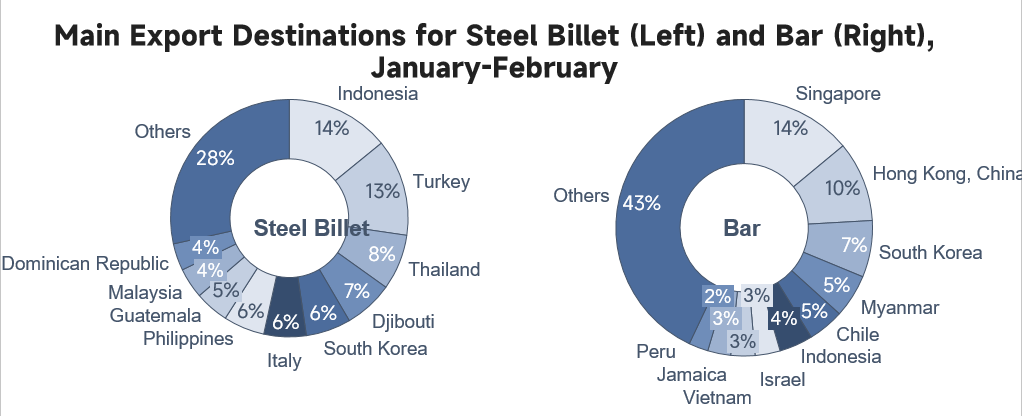
In terms of steel billet exports, the main target market in the first two months remained Indonesia. Part of the cargoes was imported by Chinese-funded or joint-venture rolling mills in Indonesia for further processing and use, thereby avoiding Southeast Asia’s import tariffs on finished steel products, while another part was supplied directly to local projects under construction. Meanwhile, Southeast Asia, Africa, and South America formed a solid base of exports. In particular, on the African side, Djibouti, as a core transshipment hub, had been handling a large volume of circulating resources. Turkey, meanwhile, saw a wave of concentrated external purchases due to delays in steel scrap vessel schedules and spot-futures price spread arbitrage. In terms of bar exports, the share to Hong Kong, China declined somewhat from the end of last year, while exports to Singapore overtook it. The main reason was that procurement in Singapore was rigidly driven by local public housing renewal and public infrastructure projects, such as the Greater Southern Waterfront, according to construction periods, with actual end-user consumption remaining relatively stable; whereas Hong Kong, China, as a capital and logistics transshipment hub, saw some earlier speculative re-export orders constrained by offshore exchange-rate fluctuations at the beginning of the year and funding borrowing costs. Traders proactively reduced some speculative exposure for financial risk hedging purposes, which led to a decline in transshipment procurement volume. Looking ahead to March, with the full blockade of the Strait of Hormuz, Iran’s semi-finished products export channels were effectively cut off. Chinese steel billet is expected to absorb these additional export orders arising from geopolitical conflict, and traders and steel mills will also accelerate shipments to markets outside China such as Southeast Asia to gain a larger replacement share. Therefore, total steel billet exports still have room to rise. By contrast, Chinese bar exports mainly rely on short-haul regional shipping routes into the inland areas within Asia, and were subject to extremely limited direct impact from the disruption of long-haul Middle East logistics. Therefore, March shipments are expected to remain stable, supported by rigid-demand restocking within the region.
Source: SMM, General Administration of Customs
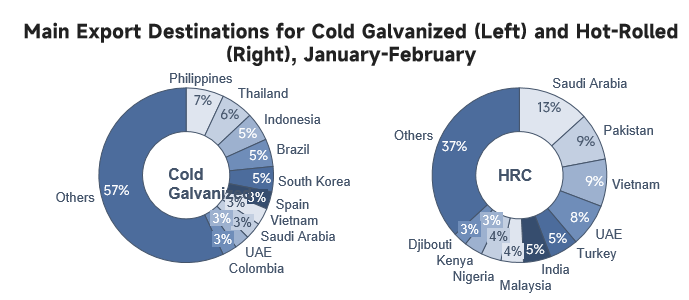
Unlike the strong performance of billets, sheets & plates exports in the first two months were unsatisfactory. The cumulative exports of both cold galvanized and hot-rolled products in January and February declined YoY, with the drop in hot-rolled products being more pronounced. However, it should be noted that before the full suspension of navigation through the Strait of Hormuz at the end of February, logistics channels to the Middle East remained open, which secured a critical delivery window for sheets & plates. Therefore, in terms of HRC exports, Saudi Arabia still firmly ranked first among export destinations with a volume of 348,000 mt, mainly because its large-scale non-oil infrastructure and manufacturing projects in China were still in an intensive construction phase, with strong end-user steel demand, which also prompted local buyers to lock in relatively lower-priced Chinese HRC ahead of shipping disruptions, thereby maintaining its leading position. Pakistan (230,000 mt), by contrast, saw this mainly due to bottlenecks in domestic supply, creating phased concentrated restocking demand, and according to the SMM survey, most purchases were made by downstream pipe factories. From the perspective of cold galvanized exports, the Southeast Asian market was currently in a stage of rapid development, and macroeconomic expansion had created a huge gap in flat steel products. Thailand in particular (304,000 mt) was in a concentrated raw material stocking cycle for local downstream auto manufacturers at the beginning of this year, so just-in-time procurement by multiple physical manufacturers directly pushed up local imports. Looking ahead to March, under the dual impact of the Strait of Hormuz blockade and the Ramadan effect, sheets & plates exports to the Middle East core region are expected to face a sharp contraction. SMM shipping data showed that steel arrivals had already declined by more than 900,000 mt. However, under the pressure of elevated destocking in China, this portion of blocked exports is expected to be redirected to Southeast Asia and other alternative markets with “rigid manufacturing demand” for redistribution, thereby offsetting shipment reductions caused by localized logistics disruptions. Therefore, there is no need for excessive concern over total sheets & plates exports in March
Source: SMM, General Administration of Customs
Copyright and Intellectual Property Statement:
This report is independently created or compiled by SMM Information & Technology Co., Ltd. (hereinafter referred to as "SMM"), and SMM legally enjoys complete copyright and related intellectual property rights.
The copyright, trademark rights, domain name rights, commercial data information property rights, and other related intellectual property rights of all content contained in this report (including but not limited to information, articles, data, charts, pictures, audio, video, logos, advertisements, trademarks, trade names, domain names, layout designs, etc.) are owned or held by SMM or its related right holders.
The above rights are strictly protected by relevant laws and regulations of the People's Republic of China, such as the Copyright Law of the People's Republic of China, the Trademark Law of the People's Republic of China, and the Anti-Unfair Competition Law of the People's Republic of China, as well as applicable international treaties.
Without prior written authorization from SMM, no institution or individual may:
1. Use all or part of this report in any form (including but not limited to reprinting, modifying, selling, transferring, displaying, translating, compiling, disseminating);
2. Disclose the content of this report to any third party;
3. License or authorize any third party to use the content of this report;
4. For any unauthorized use, SMM will legally pursue the legal responsibilities of the infringer, demanding that they bear legal responsibilities including but not limited to contractual breach liability, returning unjust enrichment, and compensating for direct and indirect economic losses.
Data Source Statement:
(Except for publicly available information, other data in this report are derived from publicly available information (including but not limited to industry news, seminars, exhibitions, corporate financial reports, brokerage reports, data from the National Bureau of Statistics, customs import and export data, various data published by major associations and institutions, etc.), market exchanges, and comprehensive analysis and reasonable inferences made by the research team based on SMM's internal database models. This information is for reference only and does not constitute decision-making advice.
SMM reserves the final interpretation right of the terms in this statement and the right to adjust and modify the content of the statement according to actual circumstances.

![[SMM Daily Hot-Rolled Coil Trading] Spot Trading Volume Increased](https://imgqn.smm.cn/usercenter/EXHJE20251217171720.jpg)
![[SMM Steel] EU initiates GOES and transformer steel safeguarding investigation](https://imgqn.smm.cn/usercenter/aPBtI20251217171717.jpg)